
Menu
Close
Menu
Close


November 9, 2026
The latest round of hyperscaler earnings marks, in our view, a turning point in how markets judge the AI build-out. The question is no longer whether demand exists, but whether the capital being deployed will earn an adequate return. In this update we examine the recent hyperscaler earnings results, Gartner's research on the economics of AI infrastructure, and what credit markets are signalling, before setting out what this means for the Fairlight portfolio.
Demand is real, and so is the bill
Cloud growth accelerated across all three major providers. AWS grew at its fastest rate in nearly five years, Google Cloud revenue more than doubled and Azure grew close to 50%.
The cash flow statements were less comfortable. Amazon and Alphabet both reported negative free cash flow for a second consecutive quarter, and signalled that spending will rise again in 2027. The market sent shares down sharply for Amazon and Alphabet, while rewarding Microsoft, the only one of the three still generating meaningful free cash flow. Investors, it seems, are no longer prepared to reward capital expenditure for its own sake. They want evidence that it will earn a return.
Will the capital earn its keep?
Recent Gartner research puts numbers on that question, forecasting AI infrastructure spending to exceed $1 trillion in 2026 and to reach $7.5 trillion cumulatively by 2030. To earn a 12% return on that capital, data centre owners would need more than $14 trillion of revenue through 2032. Gartner estimates however that no more than $8 trillion can realistically be attributed to the infrastructure (this in itself may prove a bullish assumption as current AI revenue run rate is ~$400bn). On that basis Gartner sees potential write-downs of more than $4 trillion, rising beyond $6 trillion if the hurdle matches the roughly 25% return on capital the hyperscalers earned before the build-out began.
Two features make the economics difficult. First, falling token prices via intense competition are subsidising rising usage rather than expanding margins. Second, AI chips depreciate over about five years, far faster than traditional infrastructure. Gartner expects the specialist "neocloud" providers to be most exposed, with the hyperscalers cushioned by cash flow from their existing businesses. This quarter showed that cushion being drawn down.
Credit markets are drawing distinctions
For now, debt markets are repricing the build-out rather than refusing to fund it. For the largest hyperscalers, the signal is caution rather than stress. Their credit spreads have widened relative to similarly rated companies, and Meta has turned to a large equity raising to reassure bondholders. Further down the credit spectrum the picture is starker. The cost of insuring Oracle's debt against default has reached record levels. Bonds issued by CoreWeave, the largest neocloud, now trade at distressed yields that imply a better than even chance of default within five years. Project level financing for new data centres has also become more expensive, even where the tenant is investment grade.
For weaker borrowers, low returns on capital have already become a refinancing problem. For the hyperscalers the cost is more gradual; wider spreads, more equity issuance and less balance sheet flexibility. Their true obligations are also larger than headline debt suggests, with more than $120 billion of data centre spending held off-balance sheet through leases and special-purpose vehicles.
The Fairlight View
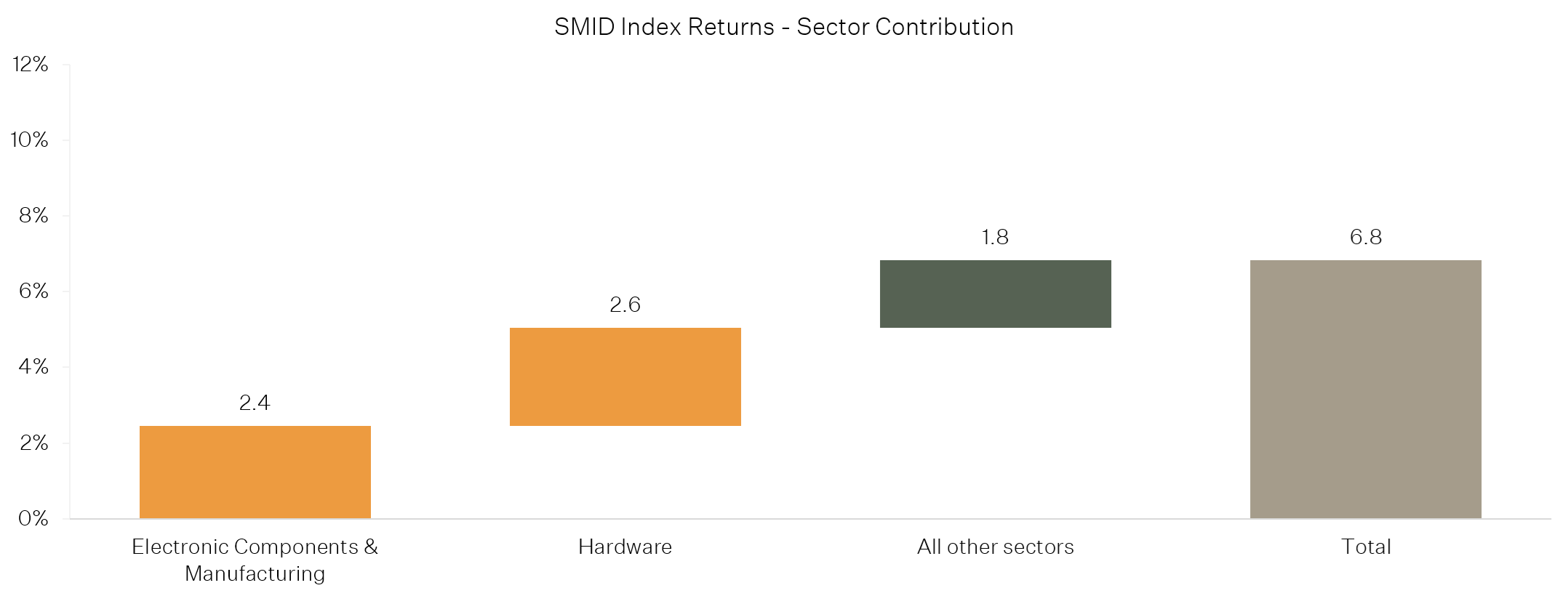
The contribution to index returns from the AI infrastructure trade have been extreme on a rolling 12-month basis, accounting for ~70% of index outcomes (orange bars, Figure 1).
Figure 1.
At Fairlight, return on invested capital has long been central to how we assess businesses, and the AI build out is now being judged on that same measure.
Some of the world's highest returning companies are becoming more capital intensive, with spending profiles that increasingly resemble utilities. Whether that capital earns an adequate return will take years to resolve, and the evidence so far suggests the outcome will vary widely between providers. Over the past month equity prices have begun to reflect this reality.
Fairlight’s portfolio is comprised of businesses which are largely capital light and are generally the market leader in their respective markets. For most of these companies, AI is an input to be used rather than infrastructure to be funded. We believe the advantage will lie with businesses that have the pricing power, proprietary data and customer relationships to absorb or pass on those costs, not with those competing to supply the compute. That is where we continue to focus.